Table of Contents
Introduction
There is a category of hardware that appears once every several years and genuinely changes what is possible on a desktop workstation. Not incrementally. Not as a percentage improvement over the previous generation. But as a categorical shift — the kind where workflows that were previously impossible on a single machine become routine, and the ceiling on what a professional can accomplish in a single working day moves noticeably higher.
The NVIDIA RTX Pro 6000 Blackwell Workstation Edition is one of those products.
NVIDIA describes it as the most powerful desktop GPU ever created — built on the Blackwell architecture and equipped with 96GB of ultra-fast GDDR7 memory. That is not marketing language from a company prone to understatement. It is an accurate description of a product that breaks several records simultaneously and arrives at a moment when professional workloads — design, engineering, visualisation, and AI — are demanding more from desktop hardware than any previous generation of tools ever has.
In this review, we will cover everything a professional in India needs to know about the RTX Pro 6000 Blackwell Workstation Edition: the architecture, the full specification, what it actually does in real-world professional workloads, who it is right for, what it costs in India, and — critically — how to determine whether the investment makes sense for your specific workflow and budget.
Background: The Blackwell Architecture
To understand why the RTX Pro 6000 represents such a significant step forward, it helps to understand the architecture it is built on.
NVIDIA’s Blackwell architecture was formally introduced at GTC in March 2024 and represents the company’s most advanced GPU architecture to date. It succeeds the Ada Lovelace architecture — which powered the RTX 4000-series consumer and RTX A-series professional cards — and brings with it substantial improvements across every performance metric: raw compute throughput, AI processing, ray tracing performance, and memory bandwidth.
The RTX Pro 6000 Blackwell Workstation Edition places NVIDIA’s GB202 GPU — the same die that powers the consumer GeForce RTX 5090 — in a housing designed specifically for desktop workstations, configured to draw up to 600 Watts.
The GB202 die is the largest and most powerful in NVIDIA’s current lineup. In the consumer GeForce RTX 5090, it is deployed at full capacity. In the RTX Pro 6000, it is similarly deployed — but with a critical difference: the professional card carries three times the video memory of the consumer flagship, uses ECC (Error Correcting Code) memory for data integrity, runs professional-grade ISV-certified drivers, and is tuned for sustained professional workloads rather than peak gaming performance.
Full Technical Specification
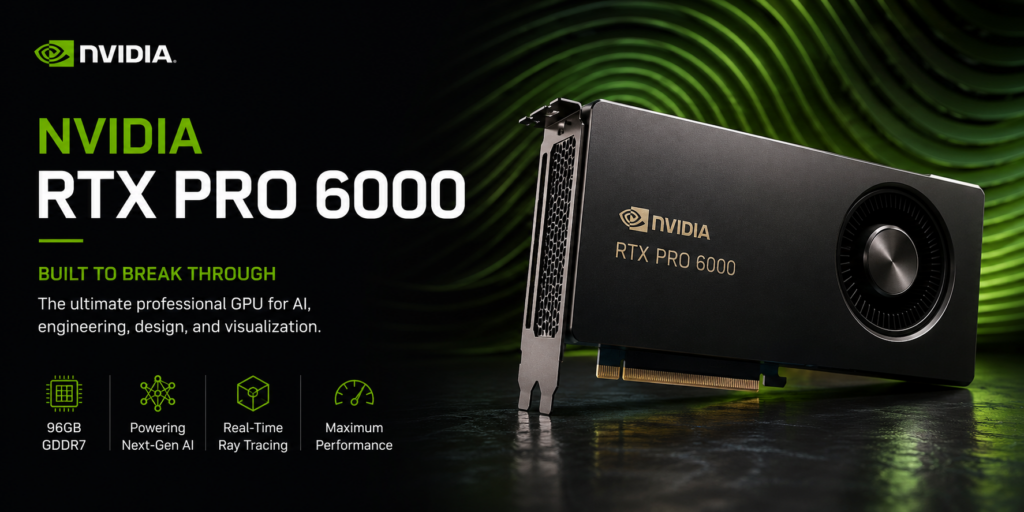
NVIDIA bills the RTX Pro 6000 Blackwell Workstation Edition as the most powerful desktop GPU ever created, noting that on paper it even edges ahead of the 32GB GeForce RTX 5090, offering higher single-precision performance along with faster AI and ray tracing capabilities.
The RTX Pro 6000 Blackwell Workstation Edition carries the following specification: NVIDIA Blackwell GPU architecture, 24,064 CUDA cores, 5th generation Tensor Cores, 4th generation Ray Tracing Cores, 4,000 AI TOPS, 125 TFLOPS single-precision performance, 380 TFLOPS RT Core performance, 96GB GDDR7 with ECC, 512-bit memory interface, and 1,792 GB/s memory bandwidth.
Here is the full specification alongside its predecessor and the consumer RTX 5090 for context:
| Specification | RTX Pro 6000 Blackwell | RTX A6000 (Ada) | RTX 5090 (Consumer) |
|---|---|---|---|
| Architecture | Blackwell GB202 | Ada Lovelace | Blackwell GB202 |
| CUDA Cores | 24,064 | 18,176 | 21,760 |
| VRAM | 96GB GDDR7 ECC | 48GB GDDR6 ECC | 32GB GDDR7 |
| Memory Bandwidth | 1,792 GB/s | 960 GB/s | 1,792 GB/s |
| Memory Interface | 512-bit | 384-bit | 512-bit |
| AI TOPS | 4,000 | ~362 | ~3,352 |
| TDP | 600W | 300W | 575W |
| PCIe | Gen 5 x16 | Gen 4 x16 | Gen 5 x16 |
| Display Outputs | 4x DisplayPort 2.1b | 4x DisplayPort 1.4 | 3x DP 2.1b + 1x HDMI |
| Form Factor | Dual-slot | Dual-slot | Dual-slot |
| ECC Memory | Yes | Yes | No |
| ISV Certified | Yes | Yes | No |
| Price (India approx.) | ₹11–12 lakh | ₹3.5–4 lakh | ₹2.5–3 lakh |
Several numbers in this specification deserve particular attention.
96GB of GDDR7 ECC is the headline figure and the one that most directly determines what this card makes possible. The RTX Pro 6000 Blackwell features 96GB of GDDR7 ECC VRAM — a 100% increase over the previous generation’s 48GB. No consumer GPU comes close to this figure. The RTX 5090 carries 32GB. The previous generation A6000 carried 48GB. The jump to 96GB is not an incremental upgrade. It is a new category.
1,792 GB/s memory bandwidth matches the RTX 5090 exactly — the fastest memory subsystem available in any desktop GPU — delivered via a 512-bit bus that moves data between the GPU cores and the memory at a rate that previous professional cards simply could not achieve.
4,000 AI TOPS from the 5th generation Tensor Cores positions this card as a local AI compute platform, not just a graphics accelerator. Fifth-generation Tensor Cores deliver up to 3x the performance of the previous generation and add support for FP4 precision and DLSS 4 Multi Frame Generation technology.
The card also carries 752 fifth-generation Tensor Cores and 188 fourth-generation RT Cores, uses a standard PCIe 5.0 x16 interface, and offers four DisplayPort 2.1b outputs for high-resolution, high-refresh-rate visualisation.
Design and Physical Characteristics
The RTX Pro 6000 Blackwell Workstation Edition is a two-fan, two-slot card in a blow-through cooler configuration, designed for use in desktop workstations and configured to draw up to 600 Watts.
The dual-slot form factor is significant. At 600W TDP, one might expect a card that requires three or four slots and specialised cooling infrastructure. The RTX Pro 6000 fits into a standard two-slot PCIe bay. It features a double-flow-through cooling design that channels airflow through dual axis pathways to ensure efficient and stable performance under 600W power loads. The cooling system manages 600W within a standard dual-slot envelope — a meaningful engineering achievement.
The card connects via a single PCIe CEM5 16-pin power connector and interfaces with the host system via PCIe 5.0 x16 — the current generation interface that doubles the bandwidth of PCIe 4.0.
Display connectivity covers four DisplayPort 2.1b outputs supporting more than four simultaneous displays at 4,096 x 2,160 at 120Hz, more than four at 5,120 x 2,880 at 60Hz, or more than two displays at 7,680 x 4,320 at 60Hz.
For professionals running multi-monitor setups — dual 4K, or a 4K primary with secondary reference displays — the RTX Pro 6000 handles all of this natively from a single card.
Three Variants: Understanding the Lineup
NVIDIA is releasing three versions of its top-end Blackwell professional card. The RTX Pro 6000 Blackwell Workstation Edition — the subject of this review — is the standard desktop configuration with a two-fan blow-through cooler drawing up to 600W. A second version, the RTX Pro 6000 Blackwell Max-Q Workstation Edition, has desktop multi-GPU in mind with a blower-fan configuration limited to 300W. Finally, NVIDIA is offering a passively-cooled RTX Pro 6000 Blackwell Server Edition for rack servers with heavy-duty server fans at an adjustable TDP of up to 600W. Other than the cooler and TDP, these cards are identical.
For most design studios, engineering firms, and professional users in India, the standard Workstation Edition reviewed here is the appropriate choice. The Max-Q is relevant for dense multi-GPU desktop configurations. The Server Edition belongs in rack infrastructure, not on a desk.
Real-World Performance: What the Numbers Mean for Professional Workflows
Specifications are meaningful only in the context of what they enable. Here is what the RTX Pro 6000 Blackwell delivers for the professional workflows most relevant to Rational Systems’ clients.
3D Design and CAD Visualisation
For AutoCAD, Revit, SolidWorks, and other CAD applications, the RTX Pro 6000’s ISV certification and professional driver stack are the foundation. Hardware acceleration is fully enabled, stable, and complete — not the partial or conditional acceleration that consumer GPUs deliver.
The 96GB of VRAM is particularly transformative for large assembly and architectural visualisation. Complex 3D models, BIM assemblies with thousands of components, and large-scale architectural renderings that would exhaust even the 48GB of the previous-generation A6000 sit entirely within the RTX Pro 6000’s memory budget.
In benchmark testing of complex scene rendering, the GPU rendered an entire scene at 4K with 128 samples per pixel in just 69 seconds. Only a few years ago, tackling a model of this complexity on a single GPU would have been unthinkable.
Adobe Photoshop and Creative Applications
For Photoshop, the combination of 96GB VRAM, 1,792 GB/s memory bandwidth, and 4,000 AI TOPS from the 5th generation Tensor Cores transforms every GPU-accelerated operation.
Neural filters — Photoshop’s AI-powered tools for sky replacement, style transfer, skin smoothing, and portrait retouching — run on the Tensor Cores directly. AI performance receives a substantial boost from both the 5th generation Tensor Cores and the card’s ability to feed those cores data more efficiently, thanks to significantly higher memory bandwidth.
For large-format print work, the 96GB VRAM buffer means composite files that would overflow any consumer card’s memory — massive PSDs with hundreds of layers at A0 resolution — live entirely in GPU memory. Viewport performance, filter application, and canvas responsiveness are uniformly fast regardless of file complexity.
Video Production and DaVinci Resolve
One professional working on high-resolution, high-frame-rate immersive media at 7,680 x 7,680 at 60 FPS reported that upgrading from an RTX A6000 with 48GB of VRAM to the Pro 6000 Blackwell reduced DaVinci Resolve render time from 5.5 hours to just 1 hour. On the same timeline, a single Pro 6000 card outperformed a configuration with dual RTX 6000 Ada cards.
A single card outperforming two of the previous generation flagship is the kind of result that redefines how professionals plan their hardware infrastructure.
AI and Local LLM Inference
This is where the RTX Pro 6000 enters territory that no previous desktop professional GPU has occupied. NVIDIA positions this GPU for mixed workflows including local LLM inference with long context, large scene rendering, complex simulation, and multi-GPU research rigs.
With 96GB of VRAM and 4,000 AI TOPS, the RTX Pro 6000 can run large language models locally that previously required cloud infrastructure or data centre hardware. Models with 70 billion parameters — which require approximately 40GB of VRAM at standard precision — fit comfortably within a single card’s memory. One user reported it working great for almost all large models available on Ollama.
For AI developers, researchers, and businesses exploring on-premise AI inference — particularly relevant given India’s growing emphasis on data localisation and privacy — the RTX Pro 6000 enables a genuinely new category of desktop AI compute.
Universal MIG: One Card, Multiple Workloads
Universal MIG (Multi-Instance GPU) support allows the RTX Pro 6000 to be divided into multiple isolated instances, each with dedicated resources, enabling concurrent execution of multiple workloads, optimised GPU utilisation, and secure isolation of different applications or users.
The supported MIG configurations are up to four instances of 24GB each, up to two instances of 48GB each, or a single full 96GB instance. For organisations running multiple users on a single workstation, or for workflows that need to run AI inference and interactive design simultaneously in isolated environments, MIG transforms a single GPU into a partitioned multi-user compute resource.
The Cooling System: Managing 600W in a Dual-Slot Card
Six hundred watts is a significant thermal challenge. It is twice the TDP of the previous generation RTX A6000 and substantially more than any previous professional desktop GPU.
Where past top-end professional cards have tended to max out power consumption at around 300W, the flagship RTX Pro 6000 Blackwell Edition specifies 600W — marking an inflection point in GPU design.
The double-flow-through cooling design addresses this by channelling airflow through two independent pathways simultaneously, managing heat across the full 600W envelope without requiring additional cooling infrastructure beyond a standard workstation chassis with adequate airflow. The result is sustained performance without thermal throttling under continuous professional workloads — the condition that matters most for all-day professional use.
Workstation builders and integrators should verify that the host chassis has adequate PSU headroom and case airflow for 600W GPU operation. A 1000W or 1200W PSU is recommended for a complete workstation build with a high-core-count CPU alongside the RTX Pro 6000.
RTX Pro 6000 Blackwell vs. RTX A4000: The Right Card for the Right Workflow
For context relevant to Rational Systems’ clients — many of whom are considering professional GPU upgrades — it is worth directly comparing the RTX Pro 6000 Blackwell against the RTX A4000 that we have previously deployed and reviewed.
| Factor | RTX A4000 16GB | RTX Pro 6000 Blackwell 96GB |
|---|---|---|
| VRAM | 16GB GDDR6 ECC | 96GB GDDR7 ECC |
| CUDA Cores | 6,144 | 24,064 |
| Memory Bandwidth | 448 GB/s | 1,792 GB/s |
| AI TOPS | ~125 | 4,000 |
| TDP | 140W | 600W |
| India Price (approx.) | ₹1.8–2.2 lakh | ₹11–12 lakh |
| Best For | Design studios, CAD, Photoshop, Illustrator | AI development, large-scale rendering, VFX, complex simulation, LLM inference |
The RTX A4000 remains the right recommendation for design professionals running AutoCAD, Photoshop, Illustrator, and CorelDraw as their primary workflow — a professional GPU at a professional price point that transforms creative and engineering workstation performance without the cost or power requirements of the flagship card.
The RTX Pro 6000 Blackwell is the right card for a different category of user: the VFX studio rendering at 8K, the AI research team running local model inference, the engineering firm working with massive BIM assemblies or simulation datasets, and the production house where a single GPU replacing two previous-generation flagship cards represents a real infrastructure and cost saving.
Price and Availability in India
The RTX Pro 6000 Blackwell Workstation Edition is available in India at approximately ₹12 lakh, with pricing varying by distributor and import channel. Globally, the MSRP was set at approximately $8,565 at its launch in March 2025, with retail prices in June 2026 typically ranging between $8,000 and $9,200.
In India, the PNY-branded version is available from specialist IT distributors at approximately ₹11.5 lakh, with pricing subject to import duties, GST, and distributor margins.
This is a premium investment — and it is priced accordingly. The relevant question is not whether it is expensive, but whether it is expensive relative to the value it delivers for the specific workflow it serves. For a VFX studio, a simulation engineering firm, an AI development team, or any professional organisation where the GPU is the primary production tool, the answer is straightforwardly yes.
Who Should Buy the RTX Pro 6000 Blackwell?
This card is the right investment for the following professional contexts:
VFX studios and animation companies running 3D rendering pipelines where scenes regularly exceed 48GB of VRAM, and where render time directly translates to project delivery schedules and client billing.
Architecture and BIM professionals working with large-scale Revit models, complex Lumion or Enscape visualisations, and multi-building assemblies that push the limits of GPU memory on any previous professional card.
AI developers and data scientists who need to run large language models, fine-tune foundation models, or develop inference pipelines locally — without cloud infrastructure — for reasons of cost, latency, or data privacy.
Video production professionals working at 4K, 8K, or higher resolution in DaVinci Resolve, Premiere Pro, or similar platforms, where render time is a daily cost and a single card replacing two previous-generation units changes the economics of a studio.
Research institutions and engineering simulation teams running CUDA-accelerated compute workloads — fluid dynamics, structural analysis, molecular simulation — where VRAM capacity and compute throughput are the direct determinants of what is feasible.
For most design professionals — graphic designers, architects working in AutoCAD and SketchUp, print designers in CorelDraw and Photoshop — the RTX A4000 or RTX Pro 4000 Blackwell (24GB GDDR7 at a significantly lower price point) remains the appropriate professional GPU. The RTX Pro 6000 Blackwell is not a better version of the same tool at a higher price. It is a different category of tool for a different category of workload.
What Rational Systems Recommends
At Rational Systems, we have been specifying and deploying professional workstations for design studios, engineering firms, and technology companies across Delhi NCR for 30 years. The emergence of the RTX Pro 6000 Blackwell represents a genuine inflection point for a specific category of professional user — one that we are actively discussing with clients who fit the profile.
Our recommendation framework is straightforward:
If your primary workflow is design, CAD, and creative production — CorelDraw, AutoCAD, Photoshop, Illustrator — and you need a professional GPU that transforms your workstation performance, the RTX A4000 or RTX Pro 4000 Blackwell is the right card at the right investment level.
If your workflow involves large-scale rendering, AI model development, 8K video production, massive BIM assemblies, or scientific simulation — and you are currently either waiting for render jobs, using cloud GPU instances, or running multiple older cards to achieve the VRAM you need — the RTX Pro 6000 Blackwell is the card that solves your problem permanently, in a single dual-slot, desktop workstation package.
If you are unsure which category you fall into, the answer is a conversation about your workflow — which is a conversation we are happy to have.
Verdict
The NVIDIA RTX Pro 6000 Blackwell Workstation Edition is the most capable desktop professional GPU ever released. That is not a claim that requires qualification or caveat.
96GB of GDDR7 ECC memory at 1,792 GB/s bandwidth. 24,064 CUDA cores. 4,000 AI TOPS from 5th generation Tensor Cores. 4th generation RT Cores. ISV-certified professional drivers. MIG support for multi-workload partitioning. All of this in a dual-slot desktop card at 600W.
It is a product that makes previously server-grade AI inference possible on a desktop. That reduces render jobs measured in hours to render jobs measured in minutes. That fits a complete large language model — 70 billion parameters — into a single card’s memory. That enables a single workstation to do work that previously required a small cluster.
For the professional whose workflow demands it, it is the most significant single hardware upgrade available today. For everyone else, the professional GPU tier has excellent options at more accessible price points — and the expertise to match the right card to the right workload is exactly what a 30-year infrastructure consultancy brings to the conversation.
Rating: 5/5 — For the professional workflows it is designed for, there is no better option on the market.
Consult Rational Systems for Professional Workstation Specification
We supply, configure, and support professional workstations for design studios, engineering firms, AI development teams, and technology companies across Delhi NCR. Whether you are evaluating the RTX Pro 6000 Blackwell for your specific workflow, or looking for the right professional GPU at any price point, we will give you an honest, workflow-specific recommendation based on 30 years of professional IT infrastructure experience.
📞 Call or WhatsApp: +91-9810017172 ✉️ Email: info@rational.co.in 🌐 Website: rational.co.in 📅 Book a consultation: calendly.com/rationalsystems
Rational Systems Private Limited has been supplying and supporting professional workstations and IT infrastructure for businesses across Delhi NCR since 1995. Trusted by design studios, embassies, manufacturing companies, and technology firms for 30 years.
Disclaimer: This is an AI generated Content with data from various sources. NVIDIA, RTX, Blackwell, CUDA, Tensor Core, and related product names are trademarks of NVIDIA Corporation. All performance figures and specifications referenced in this article are sourced from NVIDIA’s official product documentation and independent third-party reviews. Rational Systems Private Limited is an independent IT solutions provider and is not affiliated with or endorsed by NVIDIA Corporation.