Table of Contents
Introduction
Every few years, a new Wi-Fi standard arrives and the internet fills up with headlines about speed records. Wi-Fi 6: faster. Wi-Fi 7: even faster. Wi-Fi 8: faster still.
Except this time, that is not the story.
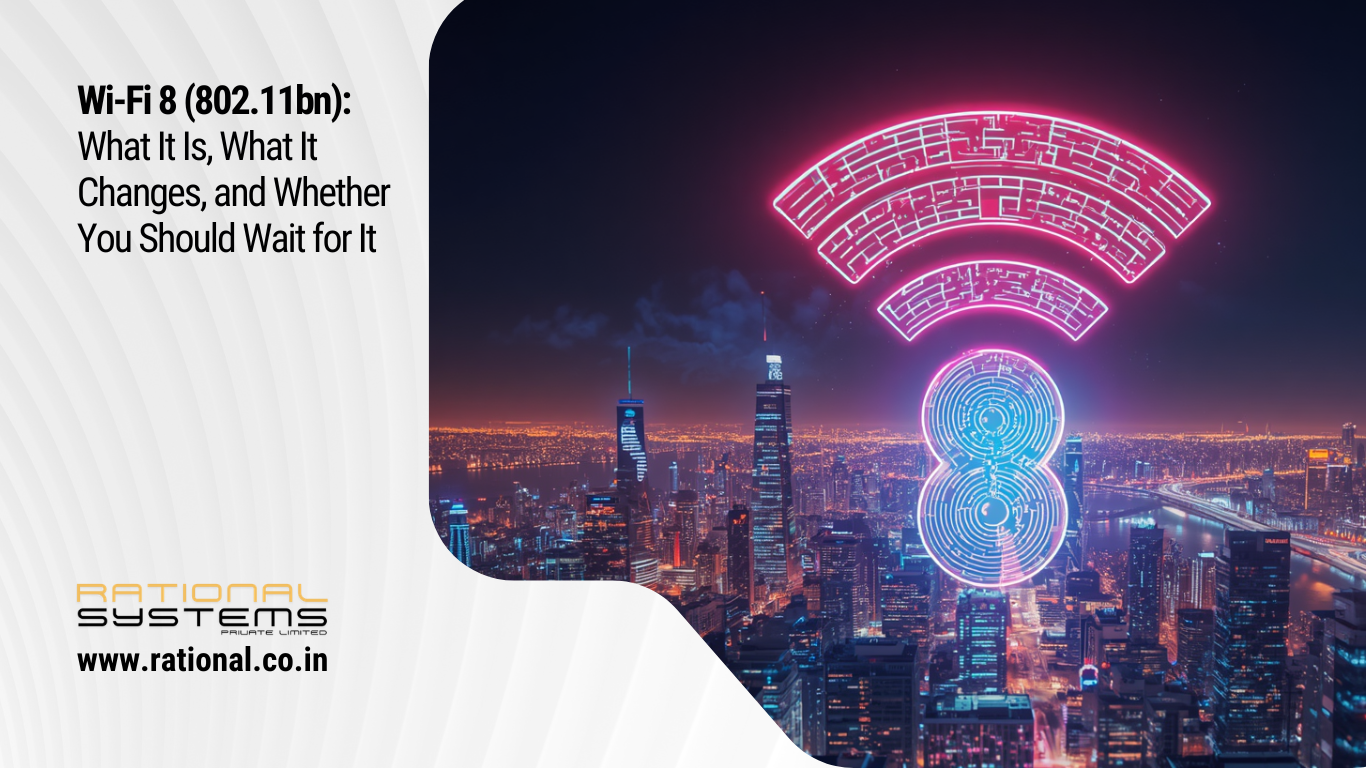
Wi-Fi 8 — officially known as IEEE 802.11bn, codenamed Ultra High Reliability or UHR — is the next generation of wireless networking, and it represents a genuine shift in the philosophy of how Wi-Fi evolves. For the first time in the history of the standard, the primary design objective is not faster peak speeds. It is reliability. Consistency. Making Wi-Fi work properly in the environments where current Wi-Fi quietly fails every day.
That shift matters enormously for the kinds of environments Rational Systems serves: large homes with dozens of connected devices, school campuses with hundreds of simultaneous connections, hotels where every guest expects flawless connectivity, and offices where a dropped call is a business problem.
In this article, we explain what Wi-Fi 8 actually is, what it specifically improves over Wi-Fi 7, when it is coming to India, what routers and access points are already appearing, and — most importantly — what you should actually do about your wireless infrastructure right now.
What Is Wi-Fi 8?
Wi-Fi 8 is the next-generation wireless standard, formally designated IEEE 802.11bn, focused on Ultra High Reliability. The IEEE Task Group working on it — TGbn — was formally established in November 2023 with a standardisation cycle that will last until 2028.
The name tells you everything about the direction: Ultra High Reliability. Not Ultra High Speed. Not Extreme Throughput. Reliability.
Wi-Fi innovations have historically focused on increasing speed, but Wi-Fi 8 signals a critical shift toward Ultra-High Reliability to meet modern digital needs. The reasoning is straightforward: most users in 2026 have more than enough raw bandwidth from their internet plans and their Wi-Fi hardware. What they do not have is consistent, reliable, low-latency wireless performance in the real-world environments they actually live and work in — dense apartments, busy offices, school classrooms, hotel lobbies, and large homes with 30 connected devices competing for the same radio spectrum.
According to preliminary objectives of the 802.11bn draft, minimum improvements of 25% are targeted on three key fronts: throughput under low signal conditions, latency at the 95th percentile, and packet loss during device mobility.
These are not marketing numbers. They are engineering targets written into the standard specification. Wi-Fi 8 is being designed to a measurable reliability benchmark — something previous Wi-Fi generations were not.
The Problem Wi-Fi 8 Is Solving
To understand why reliability is the focus, it helps to understand what actually goes wrong in real-world wireless networks — the problems that raw speed improvements do not fix.
The density problem. Wi-Fi operates on shared radio spectrum. When many devices compete for the same channel simultaneously — in a conference room, a classroom, a hotel corridor, or a densely packed apartment building — they interfere with each other. Every device must wait for others to finish transmitting before it can send its own data. As device density increases, the wait time grows and effective performance falls — even when each individual access point has excellent specifications on paper.
The interference problem. Modern environments are saturated with wireless signals. Your neighbours’ Wi-Fi networks, Bluetooth devices, microwave ovens, baby monitors, IoT sensors — all of these generate radio frequency noise that degrades Wi-Fi performance. Current Wi-Fi standards manage interference reactively, after it has already affected performance. Wi-Fi 8 is designed to manage it proactively, through coordination between access points.
The roaming problem. When a device moves between access points — walking from one room to another, moving across a hotel floor, transitioning between campus buildings — the handoff between access points can cause a measurable dip in performance or a brief connection loss. In 2026, with video calls, real-time collaboration tools, and live streaming as standard professional activities, even a brief handoff hiccup is noticeable and disruptive.
The latency problem. Many modern applications — video calls, cloud gaming, industrial IoT, real-time financial systems, remote medical monitoring — are more sensitive to latency than to bandwidth. A 4K video stream needs bandwidth. A video call needs low, consistent latency. Current Wi-Fi standards optimise primarily for throughput. Wi-Fi 8 is the first standard to explicitly target latency reduction as a primary design goal.
Wi-Fi 8 addresses all four of these problems through a set of new technical features that work together as a coherent reliability architecture.
Key Technical Features of Wi-Fi 8
1. Multi-AP Coordination — The Most Important Feature
This is the headline feature of Wi-Fi 8 and the one that most directly addresses the density and interference problems that plague real-world wireless deployments.
Wi-Fi 8 introduces enhanced coordination between multiple access points. Many Multi-AP schemes were discussed during the development of Wi-Fi 7 but were postponed due to specification complexity, so 802.11bn continues this direction. Multi-AP leverages classical Wi-Fi mechanisms — Restricted Target Wake Time, Spatial Reuse, Beamforming, and others — by enabling their cooperative work across multiple access points.
In practical terms, Multi-AP Coordination means that access points in the same network no longer operate as independent, competing radios. They communicate with each other and coordinate their transmissions to minimise interference and maximise spectrum efficiency. Coordinated TDMA enables access points to share transmission opportunities in a coordinated way, reducing collisions and improving spectrum efficiency.
The specific coordination schemes in 802.11bn include Coordinated Restricted Target Wake Time (Co-RTWT), Coordinated Spatial Reuse (Co-SR), Coordinated Beamforming (Co-BF), Coordinated Time Division Multiple Access (Co-TDMA), and Coordinated Channel Recommendation (Co-CR). These Multi-AP schemes allow access points to manage interference more effectively while sharing spectrum resources, enabling simultaneous transmissions that would otherwise conflict.
For a school with 40 access points across a campus, or a hotel with an access point in every room, this coordination capability is transformative. Instead of 40 or 90 independent radios competing with each other, you have a coordinated network that manages its shared spectrum as a single intelligent system.
2. HARQ — Error Correction That Actually Works
Wi-Fi 8 introduces Hybrid Automatic Repeat Request (HARQ) protocols. HARQ is a technology borrowed from mobile cellular networks (4G and 5G) that has been used in those standards for over a decade but has never previously appeared in Wi-Fi.
Here is why it matters. In current Wi-Fi, when a transmitted packet is corrupted by interference or a weak signal, the receiving device simply discards it and requests the sender to retransmit the entire packet. This is wasteful and adds latency — the retransmission takes time, and in a noisy environment, the retransmitted packet may also be corrupted.
HARQ changes this: instead of discarding a corrupted packet, the receiver stores it and combines it with the retransmitted version. Even a packet that arrives corrupted contains some correct information. By combining multiple imperfect copies, the receiver can reconstruct the correct packet with fewer total retransmissions — reducing the impact of interference on both latency and throughput.
In environments with physical obstacles, radio interference, or marginal signal strength — exactly the environments that describe most real-world deployments — HARQ provides a meaningful and measurable improvement in reliability.
3. Seamless Roaming Domain (SDM)
Wi-Fi 8 offers Seamless Roaming Domain (SDM) to address high latency and low reliability cases often experienced when devices move between Wi-Fi networks.
The sticky client problem — where a device clings to a distant access point instead of connecting to a closer, stronger one — is one of the most common causes of poor real-world Wi-Fi performance. Current enterprise networks manage this through proprietary mechanisms and careful configuration. Wi-Fi 8 addresses it at the standard level, defining a framework for seamless, coordinated handoff that works across access points from different manufacturers.
For large homes, school campuses, and hotels, seamless roaming at the standard level means that the walk-from-room-to-room dropped call becomes architecturally prevented — not just managed through careful engineering.
4. 16K-QAM Modulation
Wi-Fi 8 introduces 16K-QAM modulation — an upgrade from Wi-Fi 7’s 4K-QAM.
QAM (Quadrature Amplitude Modulation) determines how much data is encoded in each radio transmission. Higher QAM means more data per transmission. 16K-QAM encodes 14 bits per symbol compared to Wi-Fi 7’s 12 bits — a roughly 16% improvement in spectral efficiency under good signal conditions.
In practice, 16K-QAM is most useful when a device is close to an access point with a clean, strong signal. At greater distances or with any interference, lower QAM levels are used automatically. The improvement is real but less dramatic than the QAM leap from Wi-Fi 6 to Wi-Fi 7.
5. Enhanced Multi-Link Operation (Distributed MLO)
Wi-Fi 7 introduced Multi-Link Operation — the ability for a device to connect to an access point simultaneously across multiple frequency bands (2.4GHz, 5GHz, and 6GHz), aggregating bandwidth and improving reliability by switching between bands dynamically.
Wi-Fi 8 enhances this with distributed MLO — a more advanced and distributed implementation of Multi-Link Operation that extends the multi-link concept across multiple access points, not just multiple bands of a single access point. This means a device can maintain simultaneous connections to different access points in the network, further improving roaming reliability and throughput consistency.
6. 16 Spatial Streams (Up from 8 in Wi-Fi 7)
Wi-Fi 8 supports up to 16 spatial streams for MIMO, doubling the 8 spatial streams supported by Wi-Fi 7. More spatial streams means more simultaneous data paths between the access point and connected devices, increasing both capacity and throughput for high-density environments.
In practice, 16-stream MIMO requires access points with large numbers of antennas and is most relevant for high-density deployments — stadium wireless, large conference facilities, dense office environments — rather than typical home use.
7. Improved Power Efficiency
Wi-Fi 8 includes enhanced power-saving features for both access points and client devices. Battery-powered IoT devices — sensors, smart home devices, wearables — benefit directly from more efficient power management at the protocol level, enabling longer battery life without sacrificing connectivity.
The 802.11bn standard aims to enhance power save for access points, including mobile ones, and improve peer-to-peer operation.
Wi-Fi 8 vs Wi-Fi 7 vs Wi-Fi 6: The Full Comparison
| Feature | Wi-Fi 6 (802.11ax) | Wi-Fi 7 (802.11be) | Wi-Fi 8 (802.11bn) |
|---|---|---|---|
| Primary focus | Efficiency & density | Speed & low latency | Ultra-high reliability |
| Max theoretical speed | 9.6 Gbps | 46 Gbps | ~46 Gbps (similar) |
| Max channel width | 160 MHz | 320 MHz | 320 MHz+ |
| Modulation | 1024-QAM | 4096-QAM | 16384-QAM |
| Spatial streams | 8 | 8 | 16 |
| Multi-Link Operation | No | Yes (basic) | Yes (distributed) |
| Multi-AP Coordination | No | Limited | Full, native |
| HARQ | No | No | Yes |
| Seamless roaming | Proprietary only | Proprietary only | Standard-native |
| Key improvement | +4x efficiency vs Wi-Fi 5 | +5x speed vs Wi-Fi 6 | +25% reliability vs Wi-Fi 7 |
| Standard finalised | Yes (2021) | Yes (2024) | Expected 2028 |
| Available in India | Yes, mature | Yes, early adoption | 2027–2028 (enterprise) |
Wi-Fi 8 Timeline: When Does It Actually Arrive?
This is the most practically important question for anyone making infrastructure decisions today, and the answer is more nuanced than most headlines suggest.
TGbn (Ultra-High Reliability, aka Wi-Fi 8) has resolved around 75% of the comments from its initial ballot on D1.0 as of mid-2026, meaning the standard is progressing but still has significant work ahead.
According to the IEEE 802.11 timeline, the target final approval date of IEEE 802.11bn is set for September 2028. The certification process for related products generally launches a year before standard ratification.
However, the consumer market is moving faster than the standards process. Broadcom launched a full ecosystem of Wi-Fi 8 products in October 2025, with the retail market expected to see Wi-Fi 8 products as early as Summer 2026.
ASUS showed a Wi-Fi 8 router concept — the ROG NeoCore — at CES 2026. The ROG NeoCore is expected to arrive in 2026, long before the new Wi-Fi 8 standard is officially finalised.
For enterprise and professional deployments, the timeline is more conservative. Enterprise and operator markets will follow a more traditional adoption pattern, with such products not likely to launch until mid to late 2027.
For India specifically, the practical availability timeline looks like this:
| Segment | Expected Availability in India |
|---|---|
| Consumer routers (pre-standard) | Late 2026 – Early 2027 |
| Wi-Fi 8 certified consumer products | 2028–2029 |
| Enterprise access points (Aruba, Ubiquiti) | Mid to late 2027 |
| Mature enterprise deployments | 2028 onwards |
The key word in that first row is “pre-standard.” Early Wi-Fi 8 consumer products — like early Wi-Fi 6E and Wi-Fi 7 products before the standards were finalised — will implement draft versions of 802.11bn. Some features may work only between devices from the same manufacturer. Interoperability with the final standard is not guaranteed.
First Wi-Fi 8 Products: What Has Been Announced
Broadcom has been the most aggressive. The company launched its BCM43109, BCM6718, and BCM43840/20 chipsets — all Wi-Fi 8 capable — in October 2025, making it the first chipmaker to release a full Wi-Fi 8 product ecosystem.
ASUS showed the ROG NeoCore Wi-Fi 8 router concept at CES 2026 — a consumer gaming router targeting enthusiasts who want to get ahead of the standard.
TP-Link has reportedly tested pre-standard Wi-Fi 8 hardware internally.
Qualcomm, Intel, MediaTek, and Marvell have all announced Wi-Fi 8 chipset development programs, with products expected in 2026–2027.
For enterprise platforms — Aruba, Ubiquiti UniFi, Cisco Meraki — no Wi-Fi 8 access points have been released as of mid-2026. Enterprise vendors typically wait for standards maturity and proper ISV certification before releasing new platform generations.
The Honest Answer: Should You Wait for Wi-Fi 8?
This is the question every client asks after reading about the next generation of anything. And it deserves a direct answer.
For most homes, offices, schools, and hotels in India in 2026: No. Do not wait.
Here is why.
The Wi-Fi Alliance’s advice is clear: do not delay projects. Wi-Fi 7 is the mature standard for the 2026–2030 cycle.
Wi-Fi 7 is fully ratified, available from all major enterprise vendors, ISV-certified, and deployable today with complete confidence in interoperability and stability. It delivers multi-gigabit speeds, Multi-Link Operation, 320 MHz channels, and 4K-QAM — capabilities that significantly exceed what any real-world Indian home, school, or hotel network can practically saturate.
Wi-Fi 8 products reaching the Indian market in 2026–2027 will be pre-standard consumer devices. They will not carry the Multi-AP Coordination features that make Wi-Fi 8 genuinely valuable — those require coordinated infrastructure, not just a single router. They will not be interoperable with the finalised 802.11bn standard. And they will carry a premium price for technology that is still being written.
The scenario where Wi-Fi 8 genuinely transforms your experience — coordinated access points eliminating interference across a school campus, seamless roaming at the standard level across a hotel property, HARQ improving reliability in a dense manufacturing environment — requires enterprise infrastructure, not a consumer router. And enterprise Wi-Fi 8 infrastructure will not be ready in India until 2027–2028 at the earliest, with mature, battle-tested deployments not practical until 2028–2029.
There is one scenario where waiting makes sense: if you are planning a major new infrastructure deployment — a new school building, a new hotel, a new large office — with a construction timeline that puts the deployment date at 2028 or later, it is reasonable to plan for Wi-Fi 8 access points in that infrastructure. In that case, ensure the structured cabling (CAT6A minimum) and power infrastructure is specified for future access points, and revisit hardware procurement closer to the deployment date.
For everyone else — renovating, upgrading, or deploying now — Wi-Fi 7 is the answer.
What Wi-Fi 8 Means for India Specifically
India’s wireless networking landscape has specific characteristics that make Wi-Fi 8’s reliability focus particularly relevant for the longer term.
Dense urban environments. Delhi, Mumbai, Bengaluru, and other major Indian cities have extremely high wireless network density. An apartment building in South Delhi may have 50 to 100 Wi-Fi networks operating in the same spectrum simultaneously. Wi-Fi 8’s Multi-AP Coordination and interference management features are directly targeted at exactly this environment.
Smart home adoption. India’s premium residential market is adopting smart home technology rapidly. A 4,000 sq ft bungalow in 2026 may have 30 to 50 connected devices — smart lights, security cameras, smart locks, air conditioning controllers, home theatre systems, voice assistants. Wi-Fi 8’s improved IoT power efficiency and network management features are designed for exactly this device density.
Education technology. India’s EdTech sector is deploying digital infrastructure in schools at scale. The high-density classroom environment — 35 students, each with a device, simultaneously streaming and submitting work — is one of Wi-Fi 8’s primary target use cases. When enterprise Wi-Fi 8 becomes available, Indian school campuses will be among the most natural early adopters.
Data localisation and AI at the edge. The new AI Offload study group at IEEE 802.11 has begun work on facilitating the offloading of compute-intensive AI inference tasks to edge AI Wi-Fi access points and other Wi-Fi-enabled edge compute devices. This long-term direction — Wi-Fi infrastructure that participates in AI inference, not just connectivity — is relevant to India’s growing emphasis on data localisation and on-premise AI compute.
Our Recommendation for Delhi NCR in 2026
At Rational Systems, we are watching Wi-Fi 8 closely — and we are actively deploying Wi-Fi 7 for clients who need new or upgraded wireless infrastructure now.
Our current recommendation framework is straightforward:
Deploy Wi-Fi 7 now if you need new wireless infrastructure for a home, office, school, or hotel. Wi-Fi 7 is mature, certified, and delivers performance that far exceeds any realistic current demand. The infrastructure you deploy today — particularly the structured CAT6A cabling and PoE switching — will support Wi-Fi 8 access points when they become available, protecting your investment.
Plan for Wi-Fi 8 in new construction if your project timeline extends to 2028 or later. Specify your cabling and power infrastructure to support next-generation access points. Revisit hardware procurement closer to enterprise availability.
Do not buy pre-standard Wi-Fi 8 consumer routers expecting to solve enterprise reliability problems. A Wi-Fi 8 consumer router will not implement Multi-AP Coordination — the feature that makes Wi-Fi 8 genuinely transformative — because that requires coordinated infrastructure, not a single device.
Every professional wireless deployment we undertake begins with an RF site survey — a heat map of your property that tells us exactly what coverage you need, where to place access points, and how to configure the network for your specific environment. The hardware generation is a component of that decision. The architecture is the foundation.
Conclusion
Wi-Fi 8 is the most philosophically interesting Wi-Fi standard in the history of the technology — not because it chases a speed record, but because it finally addresses the reliability problems that have made real-world wireless performance so inconsistent for so long.
Multi-AP Coordination, HARQ, seamless roaming at the standard level, 16 spatial streams, distributed MLO — these are the features that will make Wi-Fi 8 genuinely valuable when enterprise-grade hardware becomes available. Consumers will notice lower latency and more stable streaming, gaming, and smart device performance, especially in crowded environments. Business benefits include support for mission-critical workflows in healthcare, manufacturing, and enterprise networking automation.
The standard will be finalised in 2028. Enterprise products will be mature and deployable in India by 2028–2029. Pre-standard consumer products are beginning to appear now, but they do not yet deliver the coordination features that define Wi-Fi 8’s value proposition.
The right technology for a wireless deployment in Delhi NCR in 2026 is Wi-Fi 7 — professionally surveyed, correctly designed, and properly deployed. The right technology for 2028 and beyond will be Wi-Fi 8.
We will be ready for both.
Book a Free Wireless Consultation
Rational Systems Private Limited deploys managed wireless networks for homes, schools, hotels, offices, and commercial buildings across Delhi NCR — using enterprise platforms from Aruba, Ubiquiti UniFi, etc.
Whether you are planning a new deployment, upgrading an existing network, or simply trying to understand what the right wireless investment is for your property in 2026, we will give you a straight, experience-based recommendation.
Free Wireless Site Survey available this month for Delhi NCR properties.
📞 Call or WhatsApp: +91-9810017172
✉️ Email: info@rational.co.in
🌐 Website: https://rational.co.in
📅 Book directly: calendly.com/rationalsystems